


What is KYC? The end-to-end KYC process explained [2026 guide]

 Open in ChatGPT
Key Highlights
- KYC (Know Your Customer) is a regulatory requirement, not a choice. Every bank, fintech, and regulated financial institution must verify customer identity at account opening and monitor risk throughout the relationship under the Bank Secrecy Act and FATF standards.
- The end-to-end KYC process has four stages: Customer Identification Program (CIP), Customer Due Diligence (CDD), Enhanced Due Diligence (EDD) for high-risk customers, and ongoing monitoring for suspicious activity.
- Non-compliance penalties are severe. Global AML fines totaled $3.8 billion in 2025, with individual institutions facing penalties ranging from millions to billions of dollars.
- Automated KYC platforms like Signzy reduce verification time from days to seconds, completing full identity verification in under 30 seconds through parallel processing while maintaining compliance with CIP, CDD, and AML requirements across 150+ countries.
As we move forward in this digital age, following compliances imposed on institutions, especially banks, have become inevitable. Governing bodies help businesses to stay afloat and well-oiled in this era of online fraud.
Through the process of KYC, financial institutions, like banks, can run a background check on their customer as a part of due diligence. It contains information about the customer such as their addresses, occupation, date of birth, identity details, etc. This way, institutions are protected from fraud.
Among the many rules and regulations, KYC takes up the middle stage ensuring that banks and other businesses don't fall under any scams.
KYC is an important tool for accessing global and local threats imposed by criminals. No one can emphasize enough how important measure it is to comply with KYC regulations. Banks, especially, have to follow KYC standards.
Think of it, any criminal will need money to conduct a crime. It can be anything, from human trafficking, kidnapping, and extortion to scamming people online or even being connected to the world of terrorism. They will need a bank account to store and move illicit funds. But, if a bank recognizes that the customer is a criminal, they can deny the services.

Why do we need an efficient end-to-end KYC process?
The simple answer is to prevent criminals from getting away from crimes.
Nothing is static anymore, with criminals getting hi-tech, compliances are getting dynamic too. Regulations and acts are updated timely and that's when new norms come into the picture. Every country, sector, industry, and jurisdiction has a different set of rules which makes streamlining the KYC standards harder.
Results? Better customer experiences, quick delivery of services, and reduction in delays.
If a bank doesn't comply with KYC rules? Go complacent? Hefty fines.
Global AML fines totaled approximately $3.8 billion in 2025, with TD Bank alone paying $3.09 billion for systematic AML failures. In the US, the OCC issued multiple enforcement actions in 2025-2026 against banks for BSA/AML deficiencies including inadequate customer due diligence and failure to file SARs.
The process of onboarding a customer, verifying documents, checking whether the customer has no past criminal records, customer due diligence, and transaction monitoring is the end-to-end process of KYC.
| Penalty example | Amount | Reason |
|---|---|---|
| TD Bank (2024) | $3.09 billion | Systematic AML failures, inadequate transaction monitoring, failure to file SARs |
| USAA (2022) | $140 million | BSA/AML compliance failures |
| Saxo Bank (2026) | £36.4 million | AML compliance breaches |
| CaixaBank (2026) | €30 million | AML compliance failures |
What does "end-to-end" KYC verification mean?
The end-to-end KYC process consists of four stages that work together as a continuous compliance lifecycle, not a one-time checkpoint. Each stage builds on the previous one, and weaknesses in any stage compromise the entire program.
Stage 1: Customer identification program (CIP)
How do you know your customers are who they claim to be? The Customer Identification Program is the first and most foundational stage of KYC. Under 31 CFR § 1020.220, US financial institutions must collect and verify four pieces of identifying information at account opening:
- Full legal name
- Date of birth
- Residential address (or business address for non-US persons)
- Identification number (SSN for US persons; passport or equivalent for non-US persons)
Verification can use documentary methods (government-issued photo ID, passport) or non-documentary methods (credit bureau checks, database verification, public records). Most modern KYC platforms use both simultaneously to maximize accuracy. For a detailed guide on verifying government-issued ID numbers, see how to verify a government-issued identification number.
Stage 2: Customer due diligence (CDD)
This is the next stage of the KYC verification process. Banks process the data collected in stage one. Usually, firms collect data regarding the occupation of customers, the purpose of opening an account, and the expected transaction patterns.
Under the FinCEN CDD Rule, financial institutions must:
- Identify and verify beneficial owners of legal entity customers (individuals owning 25%+ equity or exercising substantial control)
- Understand the nature and purpose of the customer relationship
- Develop a customer risk profile based on the information collected
- Assign a risk tier (low, medium, high) that determines the level of ongoing scrutiny
2026 update: FinCEN's February 2026 exceptive relief (FIN-2026-R001) streamlined beneficial ownership requirements. Financial institutions no longer need to re-identify and re-verify beneficial owners at each new account opening for existing customers. Instead, institutions can rely on prior information if the customer certifies it remains current and accurate. This significantly reduces friction for multi-account business customers while maintaining initial identification requirements.
For more on the difference between KYC and CDD, Signzy's dedicated guide breaks down where CDD begins and CIP ends.
Stage 3: Enhanced due diligence (EDD)
If a customer is believed to have a high-risk profile, they have to go through this process. A person with a high-risk profile can have political exposure or connections with people who do or can be involved in a business that is vulnerable to money laundering.
EDD is triggered when standard CDD measures are insufficient to manage the risk. Common EDD triggers include:
- Politically Exposed Persons (PEPs): Current or former holders of prominent public positions, their family members, and close associates
- High-risk jurisdictions: Customers from countries on the FATF grey or black list or the EU's high-risk third country list
- Complex ownership structures: Entities with multiple layers of ownership that obscure the ultimate beneficial owner
- Unusual transaction patterns: Activity inconsistent with the customer's stated purpose or risk profile
- Negative media or adverse information: News reports linking the customer to financial crime, corruption, or sanctions violations
EDD typically requires source-of-funds and source-of-wealth verification, senior management approval before onboarding, and more frequent ongoing reviews. For a deeper breakdown, see what is Enhanced Due Diligence and when does it apply.
Stage 4: Ongoing monitoring
Now that we have established the fact that fraudsters are always ahead of us, what if they clear all checkpoints? It's not enough to have your customer checked only once. Any spike in the transaction amount, change in business pattern, or suspicious activity should trigger a review.
Ongoing monitoring includes:
- Transaction monitoring: Automated systems analyze every transaction against the customer's expected behavior profile, flagging anomalies like sudden volume spikes, unusual counterparties, or structuring patterns. For a detailed guide, see what is transaction monitoring in AML.
- Sanctions and watchlist rescreening: Customer records are continuously checked against updated OFAC, UN, EU, and other sanctions lists. Lists update frequently, sometimes daily. For more on AML watchlist screening, Signzy's guide covers the full process.
- Periodic KYC refresh: Customer profiles are reviewed at intervals determined by risk tier (annually for high-risk, every 2-3 years for medium, every 3-5 years for low-risk). Some institutions are moving toward perpetual KYC (pKYC) where reviews are triggered by events rather than calendar cycles.
- SAR filing: When monitoring identifies potentially suspicious activity, institutions must file Suspicious Activity Reports with FinCEN within 30 days.
The four stages at a glance
| Stage | What it does | Key requirements | Timing |
|---|---|---|---|
| CIP | Verifies customer identity | Collect and verify name, DOB, address, ID number | At account opening |
| CDD | Assesses customer risk | Identify beneficial owners, understand relationship purpose, assign risk tier | At account opening, risk-based updates |
| EDD | Deepens scrutiny for high-risk customers | Source of funds/wealth, senior approval, enhanced monitoring | When risk triggers are met |
| Ongoing monitoring | Detects suspicious activity post-onboarding | Transaction monitoring, sanctions rescreening, periodic reviews, SAR filing | Continuous throughout the relationship |
What is the regulatory framework behind KYC?
KYC requirements are set by international standards bodies and enforced by national regulators. Understanding the framework helps compliance teams design programs that satisfy multiple jurisdictions simultaneously.
| Framework | Scope | Key KYC requirements |
|---|---|---|
| FATF Recommendations | Global (190+ member jurisdictions) | Recommendation 10: risk-based CDD. Recommendation 1: risk assessment. Recommendation 16: wire transfer transparency |
| US Bank Secrecy Act (BSA) | US financial institutions | CIP at account opening, CDD rule (beneficial ownership, risk profiling), SAR/CTR filing, AML program |
| USA PATRIOT Act | US financial institutions | Section 326: CIP requirements. Section 312: EDD for correspondent and private banking accounts |
| FinCEN CDD Rule (2016, updated 2026) | US banks, broker-dealers, mutual funds, futures merchants | Four pillars: CIP, beneficial ownership, risk profiling, ongoing monitoring |
| EU AML Directives / AMLR | EU financial institutions | Harmonized CDD, beneficial ownership registers, risk-based approach. AMLR applies from July 10, 2027 |
| FATF Grey/Black Lists | Global | Enhanced due diligence required for customers from listed jurisdictions |
For a comprehensive comparison of how KYC relates to AML, see AML vs KYC: what's the difference?
What are the advantages of KYC verification?
Will you believe if we said that many banks still use traditional manual processes? According to reports, customer due diligence is not adequately recorded by many banks. Heavy reliance on spreadsheets makes the data incorrect and not to mention time-consuming too.
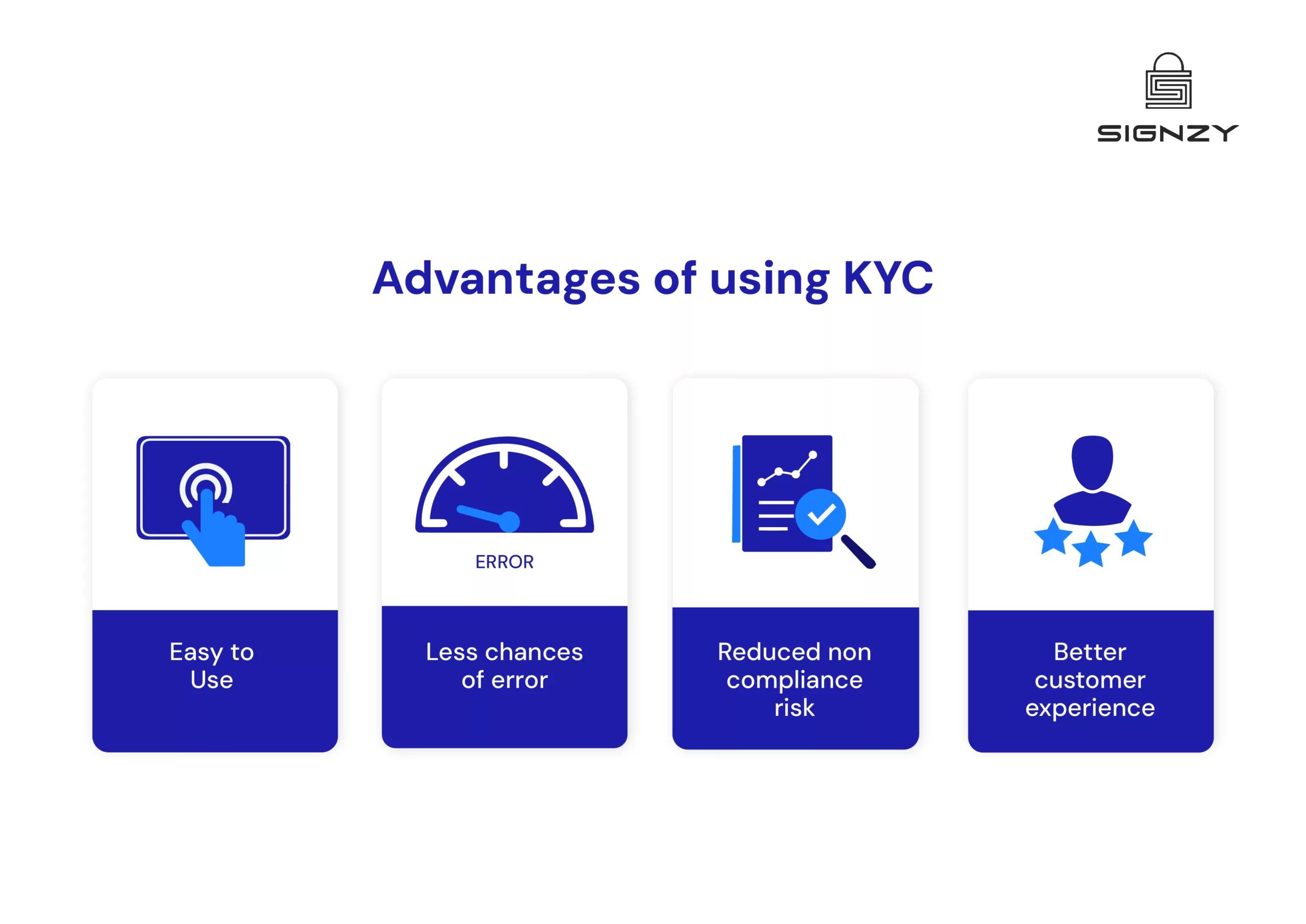
By using an end-to-end KYC process, we get the following advantages:
- Simple and easy to use: The whole process can be overwhelming if done manually. The whole process involves various parties and various complications. Using KYC, the same process is done in a fraction of time.
- Less chances of error: While handling data, humans can enter the data wrong or mix up the numbers. Allowing computers to do the same, the chances of error becomes negligible.
- Non-compliance risk: With correct documentation and processing, banks and other firms can have periodic auditing to reduce the non-compliance risk.
- Better customer experience: Suppose you are told that you can open a bank account without having to come multiple times to the bank and your loan gets approved within days. Who would leave such an opportunity?
However, everything isn't as rosy as it seems. Let's also address the thorns in the room!
There were 1.036 million reports of identity theft in the USA in 2023 alone despite banks complying with KYC regulations. Why?
Even though we have advanced technology, we lack the resources to back KYC. Now that we live in a generation where you don't need to rob a bank, you can sit in the comfort of your home and rob a bank with just a few clicks. It becomes very important to have security against such swindlers.
What are the common challenges in KYC verification?
Despite mature frameworks, KYC programs face persistent operational challenges that affect accuracy, cost, and customer experience.
| Challenge | Impact | How modern platforms address it |
|---|---|---|
| Onboarding friction | 30-50% of customers abandon document-based KYC flows | Parallel processing, database-first verification, biometric checks complete in seconds |
| False positive overload | 90%+ of AML alerts are false positives, consuming analyst time | ML-based risk scoring with dynamic thresholds and contextual screening |
| Multi-jurisdictional complexity | Different rules across 200+ jurisdictions | Unified platforms with jurisdiction-aware rule engines |
| Beneficial ownership opacity | Complex corporate structures obscure true owners | Corporate registry integration, UBO verification APIs |
| KYC refresh costs | Periodic reviews are expensive and often miss risk events | Event-driven perpetual KYC (pKYC) triggered by material changes |
| Synthetic identity fraud | Criminals combine real and fake data to pass CIP checks | Multi-layer verification combining database, document, and biometric checks |
How does Signzy streamline the end-to-end KYC process?
Signzy can help you simplify your KYC compliance. With the help of Signzy's KYC API, financial organisations can instantly get insights into data breaches, confirming the accuracy of consumer data and spotting any dangers.
Signzy's One Touch KYC platform addresses each stage of the end-to-end process:
- CIP automation: Document OCR, face matching, liveness detection, and database verification run in parallel, completing full identity verification in under 30 seconds. Supports driver's license verification across 41 US states, SSN validation, and 6,000+ document types across 240+ countries.
- CDD and beneficial ownership: Automated risk profiling, beneficial ownership identification, and customer risk tier assignment through configurable no-code workflows.
- EDD support: Configurable escalation paths for high-risk customers, with PEP screening, sanctions checks, and adverse media monitoring built into the verification flow.
- Ongoing monitoring: Integrated transaction monitoring and AML screening that continuously assesses customer risk after onboarding, with automated SAR-ready alert workflows.
Deployment typically takes 48 hours, with usage-based pricing and no minimum commitments.
Schedule a demo to explore Signzy's KYC solutions.


FAQ
What are the main components of KYC verification?

What is the difference between KYC and AML?
How long does the KYC verification process take?
What documents are required for KYC verification?
Can KYC be done fully online?
What happens if a company doesn't comply with KYC regulations?
What is the difference between CDD and EDD in KYC?
Shivam Agarwal
Shivam heads the go-to-market strategy at Signzy. He holds the CFA charter and a strong background in financial operations, PE analysis and strategy. His prior roles include business strategy and private-equity analysis in the financial services and fintech domain, giving him deep insight into client needs, risk-adjusted economics and monetisation models for compliance & identity verification platforms.

Related Blogs
View all![10 Best KYC Software Providers of 2026 [US Guide]](https://cdn.sanity.io/images/blrzl70g/production/008b1ea8636a5a1febcd10331269d51c5c29090e-3985x933.jpg)

10 Best KYC Software Providers of 2026 [US Guide]

Global KYC Compliance Process By Region: US, Canada, Europe, MEA
![AML Watchlist Screening Guide: Regulations, Tools, and More [2026]](https://cdn.sanity.io/images/blrzl70g/production/d6f119be39abfc6cd718c86eb5a401ddc6d44e66-1920x450.png)
AML Watchlist Screening Guide: Regulations, Tools, and More [2026]

10 Best Identity Verification Solutions in 2026: Full Breakdown
The best in business


The global API marketplace for KYC, KYB, & AML
Explore the end-to-end verification stack trusted by 1,000 businesses.
Get in touch