


Digital Onboarding in 2026: What Fintechs Get Right and Banks Can Copy
By Signzian
 Open in ChatGPT
🗒️ Key Highlights
- Digital onboarding lets a customer open an account remotely: they verify their identity, pass KYC and AML checks, and start using the product without visiting a branch.
- Abandonment is still the biggest problem. Cornerstone Advisors' 2026 benchmark found 3.36 online checking-account applications abandoned for every one completed in 2025.
- Fintechs tend to win on design: fewer fields, prefilled data, instant ID and selfie checks, and clear progress steps. The compliance rules are the same as for banks.
- New digital IDs are arriving: US banks may accept mobile driver's licenses under FinCEN's September 2026 guidance, and EU countries must offer digital identity wallets by the end of 2026.
- Some Banks Still Use Inefficient Traditional Methods To Onboard New Customers
- Why The Banks Aren’t Doing A Great Job at Digital Onboarding of Customers?
- Why Do Younger And Older Generations Respond Differently To Digitization?
- Fintech Startups Are Doing It Different… And Better
- What Can The Traditional Banks Adopt To Improve Their Services?
- Digital Identity Changes Shaping Onboarding in 2026
- Conclusion
- FAQ
Quick answer: Digital onboarding is the process of signing up a new customer entirely online: collecting their details, verifying their identity with an ID document, a selfie, or a trusted database, screening them for AML risk, and opening the account, often within minutes. Fintechs and neobanks generally do it better than traditional banks, not because the rules are lighter, but because they design the flow around the customer and automate the checks.
For a step-by-step explanation of the process itself, see our guide to the digital onboarding process. This article looks at why onboarding experiences differ so much, how customers of different ages respond, and what banks can borrow from fintechs.
💡 Related Blog:

Some Banks Still Use Inefficient Traditional Methods To Onboard New Customers

New customer onboarding is one of the most important issues retail banks face. When someone visits a website or walks into a branch to open a new account the bank doesn’t have a relationship with the customer, yet. It simply has a new account holder and actions need to be taken to move that relationship forward to become a long term profitable banking client.
Traditional methods trying to accomplish these goals are outdated, inefficient, and ineffective consisting primarily of paper brochures and phone calls from personal bankers.
Most financial institutions have since moved customer onboarding into apps and websites.
Most of them though haven’t done this efficiently. Traditional banks form a major portion of this category while the neo-banks including fintech startups have done a far better job.
Usually, Traditional onboarding involves:
- Hardcopies of documents
- In-person verification
- 2–3 days required for onboarding
- An excessive requirement of space for storage
- Dreadful onboarding experience
This can be a long and excruciating process and the only reason customers put up with it was because of a lack of alternatives. In a way, almost all the existing financial services followed the same process.
Neobanks and fintechs changed that. They gave customers a real alternative and built their products around what customers increasingly expect: everything digital, remote, and fast. Their growth pushed traditional banks to rebuild their own onboarding.
Why The Banks Aren’t Doing A Great Job at Digital Onboarding of Customers?
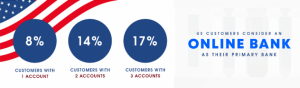
Most banks backed by regulators have slowly but steadily moved towards incorporating digital onboarding into their process.
Many banks now offer online account opening, but the experience often falls short. Common problems include:
- Too many fields and steps: long forms ask for information the bank could prefill or verify automatically.
- Manual review: applications get paused for a human to check documents, so a "digital" process still takes days.
- Weak mobile design: document and selfie capture that fails on phones, or flows that only work on desktop.
- Unclear progress: customers don't know how many steps remain or why information is needed.
The cost shows up in abandonment. Cornerstone Advisors' 2026 Digital Banking Performance Metrics report, produced with Alkami, found 3.36 online checking-account applications abandoned for every one opened in 2025, barely changed from 3.38 in 2024. In a 2025 Blend survey of 100 financial services leaders, 53% reported deposit-account application abandonment of 25% to 40%, and 37% reported 40% to 65%.
Why Do Younger And Older Generations Respond Differently To Digitization?
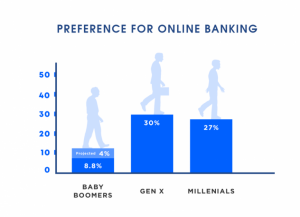
Age shapes expectations. Younger customers who grew up with smartphones expect to open an account in a few taps and are quick to abandon a slow flow. Older customers are often comfortable with online banking too, but they are more likely to value reassurance: clear explanations of why data is needed, visible security, and the option to get help from a person.
A good digital onboarding flow serves both. It keeps the steps short for confident users and offers clear guidance, accessible design, and a fallback such as video or branch support for anyone who gets stuck.
Fintech Startups Are Doing It Different… And Better
Fintech Startups acknowledge the customers’ needs to a great extent plus being the upstarts in an industry dominated by behemoths they had to find ways to optimize costs and play on their strengths.
That’s one of the major reasons why they optimized user experience over everything else (since everything else was usually well defined by the regulators) leading to their digital onboarding systems to cater to even the most unfamiliar users. What might take days at traditional banks could be done within hours or even minutes through the new banks.
They also design for the long term. Winning younger customers early builds loyalty, so fintechs make onboarding fast for them while keeping it simple enough for less confident users. The aim is to get the customer through verification and into the product with as little effort as possible.
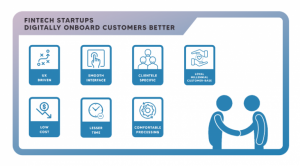
In brief, some of the important steps taken by fintech startups to better their customers’ digital onboarding journeys are:
- User Experience driven process
- Easy interface for onboarding
- No or Low Cost of Onboarding
- Reduced Time for Onboarding with Automation
- Defining Clientele for Long Term Benefits
- Comfortable Onboarding Process
- Developing Loyal Millennial Customer-base
What Can The Traditional Banks Adopt To Improve Their Services?
In theory, the Traditional Banks should acknowledge and adopt the right approaches Fintech Startups use to improve their customer onboarding. But in closer observation, we will see that all that the new banks are doing will not benefit the Traditional Titans. The methods require scrutiny before implementation.
A good example is how different the primary clientele is for both groups in terms of age. A ditto approach of focus on newer generations will distance the traditional bank’s existing customers. But a good plan to secure future customers must also be implemented. Hence, Traditional Banks have the task of retaining their existing customer base while expanding it into newer generations.
Many banks now partner with fintechs and identity verification providers instead of building everything in-house. Plugging in proven document, biometric, and database checks through APIs is usually faster than developing them internally.
Along with this, banks need to improve the overall experience of the customer. This results in:
- Better User Experience
- Lower Cost of Onboarding
- Faster Processing
- And all the aforementioned benefits of digital onboarding
Digital Identity Changes Shaping Onboarding in 2026
- United States: In September 2026, FinCEN and the federal banking agencies confirmed that banks and credit unions may accept mobile driver's licenses and other government-issued verifiable digital credentials for identity verification under the Customer Identification Program rule. Our CIP guide explains the conditions.
- European Union: Every member state must offer at least one European Digital Identity Wallet by the end of 2026. From December 2027, banks and other private services that require strong user authentication must accept the wallet when a customer chooses to use it.
- India: The RBI's KYC Directions allow Aadhaar-based e-KYC, DigiLocker documents, records from the Central KYC Records Registry, and video KYC, which is treated on par with face-to-face identification. See how banks verify identity online.
Conclusion
Digital onboarding is now the default way customers open accounts. The institutions that win are the ones that make it short, clear, and trustworthy, using automated identity checks so genuine customers get through in minutes while fraudsters are stopped. Banks don't need to copy fintechs wholesale, but they can adopt the same design principles and verification tools.
About Signzy
Signzy provides identity verification, KYC, and AML APIs that banks and fintechs use to build fast digital onboarding, including video KYC and identity verification for markets around the world.
Visit www.signzy.com for more information about us.
You can reach out to our team at reachout@signzy.com
Written By:

Signzy
Written by an insightful Signzian intent on learning and sharing knowledge.


FAQ
What is digital onboarding?

Why do customers abandon digital onboarding?
Is digital onboarding as secure as in-person verification?
Can banks accept mobile driver's licenses during onboarding?

Signzian

Related Blogs
View all

What is the digital onboarding process?

AI-Based Digital Onboarding Transforming Banking Organizations

How Banks Verify Your Identity Online: Digital KYC Explained (2026)

Top 10 KYC Companies for US Fintech Onboarding in 2026: 7-Point Comparison Across CIP, AML, Liveness, Document OCR, Fraud Signals, APIs, and 30-Day Implementation
The best in business


The global API marketplace for KYC, KYB, & AML
Explore the end-to-end verification stack trusted by 1,000 businesses.
Get in touch