


7 Best EIN Verification Services in 2026: Features & Best Picks
- EIN verification validates tax identification numbers against IRS records to prevent filing errors, reduce penalties, and confirm business legitimacy before establishing vendor relationships or processing payments.
- Solutions range from the free IRS TIN Matching Program for eligible filers to specialized databases like EINsearch and comprehensive API platforms like Middesk and iDenfy.
- Signzy combines sub-second verification speeds with consolidated business intelligence across 50 US states and 180+ countries, serving 1,800+ financial institutions with 340+ APIs.
Every business that pays contractors, vendors, or service providers in the United States needs to verify Employer Identification.
The challenge is that the IRS does not offer a public EIN lookup database. Businesses must either use the government's TIN Matching Program (which requires weeks of registration and prior filing history), manually search scattered public records, or purchase access to commercial verification services.
The right choice depends on how many EINs you need to verify, whether you require real-time API integration, and what additional business intelligence you need beyond basic tax ID confirmation.
If you're wondering whether to go with free government tools, paid databases, or automated API solutions, below is a breakdown of each method, touching on their features and strengths. Let's start.
Quick comparison: 7 Best EIN verification services in the US
TLDR Comparison Table: 7 Best EIN Verification Services
| Service | Description | Best For |
|---|---|---|
| Signzy | AI-powered platform with 340+ APIs serving 1,800+ financial institutions globally, offering direct IRS integration, consolidated business intelligence (UBO, watchlist, bankruptcy checks), and multi-country verification across 180+ countries with 0.9-second response times | Enterprises and startups needing comprehensive US and global verification with bulk processing, cross-border compliance, and consolidated due diligence capabilities |
| EINsearch | Proprietary database of 20M+ verified EINs with IRS TIN matching integration and affordable team pricing | Small to mid-size accounting firms and AP departments needing straightforward 1099 compliance verification |
| IRS TIN Matching | Free government service providing direct validation against IRS master files with 24/7 availability | Eligible payers with prior filing history who can wait weeks for registration approval |
| SEC EDGAR | Free SEC database with 20+ years of public company filings and real-time updates | Organizations verifying public companies only, willing to manually extract EIN data from documents |
| iDenfy | Global KYB platform with integrated EIN verification across 180+ business registries in 120+ countries | International businesses needing multi-country verification within customizable compliance workflows |
| Equifax Business | Credit bureau-based verification with bankruptcy checks and direct IRS integration | US businesses prioritizing credit risk assessment alongside EIN validation |
| Middesk | Business identity platform with direct IRS and 50-state Secretary of State connections, automatic monitoring, and manual review fallback | Financial institutions and lenders requiring authoritative US business data with ongoing monitoring for compliance |
What is EIN verification?
EIN verification is the process of confirming that an Employer Identification Number is valid, active, and correctly associated with a specific business entity registered with the IRS.
How can EIN verification help with US compliance?
EIN verification directly addresses multiple federal and state compliance requirements that govern business transactions and tax reporting:
🟢 IRS Form 1099 reporting requirements: Businesses must file Form 1099 for payments exceeding $600 to contractors and vendors. Verifying the recipient's EIN before filing prevents mismatches that trigger IRS notices, penalties for incorrect information reporting, and costly correction processes that delay your tax reporting cycle.
🟢 Backup withholding obligations under IRC Section 3406: When a payee fails to provide a valid TIN or the IRS notifies you of a mismatch, you're required to withhold 24% of payments as backup withholding. EIN verification helps you avoid triggering these withholding requirements and the administrative burden of remitting withheld amounts to the IRS.
🟢 Know Your Customer (KYC) and anti-money laundering standards: Financial institutions and certain businesses must verify the identity of entities they transact with under the Bank Secrecy Act and FinCEN regulations. Confirming a valid EIN is a foundational step in establishing that a business entity exists and operates legally within the US regulatory framework.
🟢 State business licensing and registration verification: Many states cross-reference federal EINs with state tax accounts and business registrations. Verifying EINs ensures consistency across federal and state filings, preventing complications with state tax withholding, sales tax permits, and maintaining good standing with state revenue authorities.
What to look for in an EIN verification service: 5 must-have features
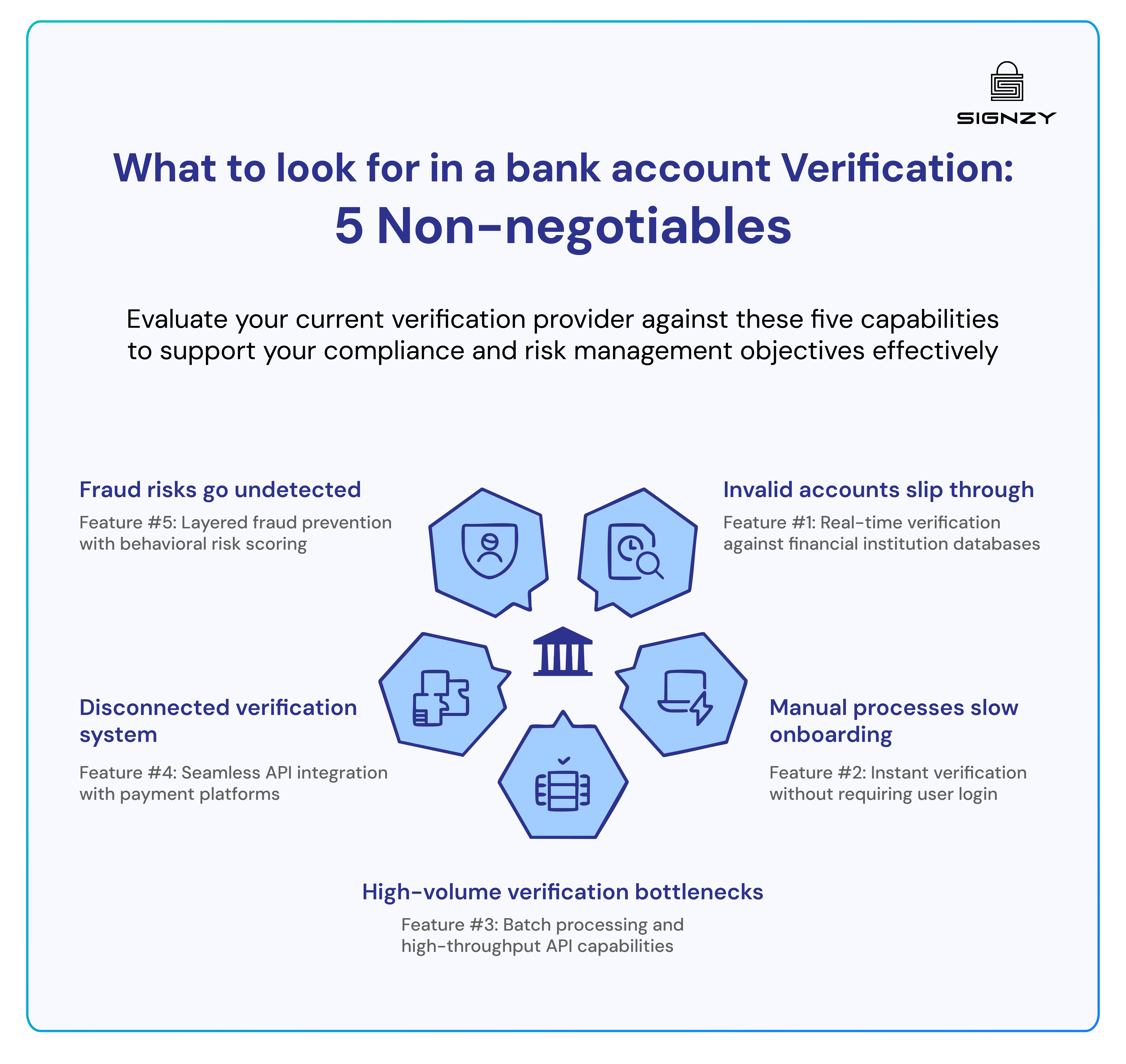
Reliable EIN verification service should provide these five capabilities to support your compliance and risk management objectives:
Feature #1: Real-time verification against IRS databases
The service should query current IRS records to confirm an EIN's active status, not rely on outdated or third-party datasets. Real-time verification ensures you're working with the most current information available, catching dissolved entities, revoked numbers, or administrative changes that could invalidate your compliance documentation. Delays of even a few weeks in data updates can expose you to filing errors.
Feature #2: Business name and entity type matching
Beyond confirming an EIN exists, the service must validate that the number corresponds to the correct legal business name and entity structure. This cross-reference catches data entry errors, identifies potential fraud where someone provides a valid but unrelated EIN, and ensures your records align with official IRS registrations before you process payments or file forms.
Feature #3: Batch processing capabilities for volume verification
If you manage hundreds or thousands of vendor relationships, manual one-by-one verification becomes impractical. Batch processing allows you to upload multiple EINs simultaneously and receive verification results in bulk, maintaining efficiency during onboarding periods, annual vendor reviews, or pre-filing audits without creating workflow bottlenecks.
Feature #4: API integration with accounting and payment systems
Standalone verification tools that require manual data export create unnecessary friction and increase error risk. API connectivity enables automatic verification within your existing accounts payable, procurement, or payment platforms, flagging issues at the point of vendor setup rather than discovering problems during tax season when corrections are costly.
Feature #5: Detailed audit trails and compliance documentation
Regulators expect you to demonstrate due diligence, not just claim you performed it. The service should generate timestamped verification reports, maintain historical records of checks performed, and provide documentation suitable for audit defense. This creates a clear evidence trail showing when verification occurred, what data was confirmed, and who initiated the check.
7 Best EIN verification services in the US
1. Signzy
Signzy is an AI-powered identity verification and compliance platform founded in 2015 that serves over 1,800 financial institutions globally. The company provides 340+ APIs covering KYC, KYB, AML, and fraud detection across 180+ countries, with particular strength in US business verification through direct connections to IRS and Secretary of State databases.
Signzy processes over 10 million verifications monthly with a 99% success rate and maintains ISO 27001 and SOC 2 Type II for enterprise security requirements.
Signzy EIN verification API - Key Features
Feature 1: Real-time verification with 0.9-second response times
Signzy returns API responses in 0.9 seconds while querying multiple authoritative databases simultaneously. This allows organizations to verify hundreds of vendors during peak periods without workflow delays or staffing increases. Real-time processing enables instant validation at the point of data entry, catching errors immediately rather than discovering mismatches during quarterly reconciliation or tax filing.
Manual verification processes that take minutes per lookup create bottlenecks during high-volume onboarding periods, forcing teams to choose between speed and thoroughness. Slow verification APIs disrupt user experience during vendor registration, leading to abandoned applications and delayed business relationships. Signzy's sub-second response time eliminates these friction points entirely.
Feature 2: Consolidated business intelligence beyond EIN matching
Signzy's verification request can return comprehensive business profiles, including tax identification validation, Secretary of State registration details, UBO information, bankruptcy filings, and watchlist screening results under the same platform. Organizations eliminate coordination overhead and reduce total verification costs by consolidating six separate checks into one platform relationship with unified reporting and audit trails.
"Annual vendor review meant checking 800+ EINs manually through various databases. Took our team almost two weeks every year. Signzy's bulk upload processes the entire list overnight. That time savings alone justified the cost immediately." — Finance Manager, Digital Payments Platform
Feature 3: Bulk processing with API and CSV upload options
Signzy supports both real-time API integration for individual verifications and bulk CSV upload for batch processing of vendor lists. Organizations validate thousands of EIN entries simultaneously during annual reviews, with results returned in structured formats ready for downstream accounting or payment systems without custom scripting or manual data transfer.
Organizations conducting annual vendor reviews or processing large onboarding backlogs face manual one-by-one verification that becomes impractical when managing vendor lists exceeding 500 entries. Accounting teams preparing for tax season need to validate thousands of Form 1099 recipients simultaneously rather than spreading verification across weeks. Signzy's bulk processing handles these scenarios efficiently.
Feature 4: No-code workflow builder for custom compliance requirements
Signzy allows teams to configure verification sequences through a visual dashboard without developer resources, enabling or disabling specific checks based on entity type, transaction value, or jurisdiction. This flexibility allows organizations to meet varying compliance requirements across different business units or product lines while maintaining centralized oversight. Teams can adjust workflows within hours rather than waiting for development cycles.
Different business units often have varying compliance requirements based on transaction values, entity types, or jurisdictions, yet most verification platforms offer rigid workflows. Modifying verification logic typically requires development tickets and sprint planning, preventing compliance teams from adapting quickly to regulatory changes. Signzy's no-code builder puts control directly in compliance teams' hands.
Signzy pros
✔️ Sub-second EIN verification at 0.9-second API response times: Multiple authoritative databases are queried simultaneously, enabling real-time validation at the point of vendor data entry rather than discovering mismatches during quarterly reconciliation or tax filing cycles.
✔️ Consolidated business intelligence beyond EIN matching in a single platform: Tax ID validation, Secretary of State registration details, UBO data, bankruptcy filings, and watchlist screening are returned under one API call, eliminating the coordination overhead of managing six separate vendor relationships.
✔️ Bulk processing via both REST API and CSV upload: High-volume organizations can run thousands of EIN validations simultaneously during annual vendor reviews or 1099 preparation cycles without custom scripting or manual data transfer between systems.
✔️ No-code workflow builder for compliance teams: Verification sequences can be configured, adjusted, and deployed through a visual dashboard without developer tickets or sprint planning, allowing compliance teams to respond to regulatory changes in hours rather than weeks.
✔️ Cross-border coverage across 180+ countries alongside US EIN verification: International businesses can verify US vendors and global counterparties through the same platform, removing the need for separate regional vendor relationships.
✔️ 48-hour implementation timeline with 99% verification success rate: Organizations can go from API access to live verifications significantly faster than legacy KYB platforms that require months of integration, reducing time-to-compliance for new product lines or market entries.
Signzy cons
❌ Pricing is not publicly disclosed: Custom quote-based pricing makes it difficult for smaller organizations to evaluate cost fit upfront without engaging a sales conversation, unlike platforms such as Shufti Pro with transparent per-verification rates.
2. EINsearch
EINsearch operates a proprietary database of over 20 million verified EINs with direct connectivity to IRS TIN matching systems. The service targets accounting firms, tax preparers, and accounts payable departments that need straightforward EIN verification for 1099 compliance. EINsearch positions itself as an affordable alternative to enterprise KYB platforms for organizations processing moderate verification volumes.
EINsearch - Key Features
- Database search with IRS TIN matching integration: Users can search the proprietary database of 20 million verified EINs or validate name and TIN combinations directly against IRS records. Both methods return results within seconds through an interface designed for non-technical users.
- API access for accounting software integration: EINsearch provides API connectivity, allowing financial institutions, accounting platforms, and tax software to embed verification functionality directly into existing workflows. This eliminates manual data entry between systems during vendor onboarding.
- Multi-user access with affordable pricing tiers: The service offers monthly and annual subscription plans structured for teams that need to share access. Pricing targets small to mid-size businesses that find enterprise KYB platforms prohibitively expensive for basic verification.
EINsearch pros
✔️Specialized 1099 compliance tooling: Direct integration with IRS TIN Matching allows name-and-EIN pairing validation, reducing CP2100 notice risk and backup withholding triggers under IRC Section 3406.
✔️Affordable subscription tiers for SMBs: Subscription pricing structured for small-to-mid-size accounting and AP teams, making it one of the most cost-accessible commercial EIN services for teams processing moderate volumes.
✔️Reverse lookup capability: Supports forward search by business name to retrieve associated EINs—functionality that the free IRS TIN Matching Program does not offer, reducing vendor onboarding friction.
✔️Simple interface with low training overhead: Browser-based dashboard with straightforward search and validation flows enables non-technical users to onboard quickly without developer resources or compliance training.
✔️API access for accounting software integration: REST API enables embedding verification into existing AP, tax, or procurement platforms, reducing manual re-keying errors during vendor onboarding cycles.
EINsearch cons
❌US-only coverage with no international entity support: The platform is limited to US EIN/TIN validation and cannot verify businesses registered in Canada, EU, UK, MENA, or APAC jurisdictions—a hard constraint for multinational organizations.
❌No embedded KYB, AML, or UBO capabilities: The platform verifies tax IDs but does not surface beneficial ownership data, sanctions screening, bankruptcy filings, or AML checks. Organizations with KYB obligations must maintain separate vendor relationships.
❌Proprietary database freshness not independently verified: The 20M+ EIN database's update frequency and methodology are not publicly disclosed, creating uncertainty about whether dissolved or dormant entities are accurately reflected.
❌Limited audit trail depth for regulatory defense: Basic verification outputs may not satisfy auditor expectations for comprehensive KYB compliance documentation under BSA/FinCEN frameworks requiring evidence of due diligence process.
❌Batch processing capability is limited relative to API-first platforms: High-volume organizations (500+ EINs/month) may encounter throughput constraints compared to enterprise-grade API platforms designed for bulk concurrent processing.
Best For: Small-to-mid-size accounting firms, tax preparers, and AP departments with primarily US vendor bases requiring affordable 1099 compliance validation. Not suitable for regulated financial institutions with KYB, AML, or cross-border obligations.
3. IRS TIN Matching Program
The IRS TIN Matching Program is a free government service that allows authorized payers to verify taxpayer identification numbers directly against IRS master files before filing information returns. Launched in 2003 and expanded beyond federal agencies, the program helps organizations prevent TIN-related errors that trigger backup withholding requirements and IRS penalties.
Access requires registration through the IRS e-Services portal, and eligibility is limited to entities that have filed at least one information return in the previous two tax years.
IRS TIN Matching Program - Key Features
- Direct validation against IRS master files: All verifications query the authoritative IRS database rather than third-party aggregators. The system returns single-character response codes indicating exact match, partial match, or no match status for each name and TIN combination submitted.
- No cost for eligible payers: The service is completely free for authorized users who meet eligibility requirements. Organizations avoid subscription fees while accessing the same government data that powers commercial verification services, though registration and approval can take several weeks.
- 24/7 availability with voluntary participation: The system operates around the clock with minimal downtime for data updates. Participation is voluntary and does not expose organizations to increased penalties, making it a pure risk reduction tool for compliance-focused teams.
IRS TIN Matching Program pros
✔️Authoritative IRS-source data with zero intermediary risk: Validation queries IRS master files directly rather than third-party aggregates, eliminating data staleness, aggregator error, or coverage gaps present in commercial databases.
✔️Zero cost for eligible payers: No subscription, per-verification, or API fees for authorized users—organizations avoid recurring vendor spend for basic 1099-focused EIN validation.
✔️24/7 operational availability with minimal downtime: Government-hosted infrastructure maintains consistent uptime outside of scheduled maintenance windows, supporting year-round verification needs without SLA dependency on a commercial vendor.
✔️Reduces CP2100 notices and backup withholding exposure: Successful TIN Match confirmation before 1099 filing directly prevents IRS penalty notices and the administrative burden of 24% backup withholding remittance under IRC Section 3406.
IRS TIN Matching Program cons
❌2–4 week registration process blocks immediate access: Organizations must pre-register through IRS e-Services and demonstrate prior filing history, making the tool unavailable for new filers or businesses with urgent verification needs.
❌Eligibility restricted to entities with prior filing history: New businesses, startups, and entities without a 1099/information return filing record in the prior two tax years cannot register, creating a coverage gap for growing organizations.
❌No API access or batch automation: The program does not offer a developer API, bulk upload endpoint, or integration with accounting/AP platforms. Verification is manual, requiring users to log in and enter records individually or in small batches.
❌No business intelligence beyond TIN status: The system only confirms match/mismatch status. It does not return business name, entity type, UBO, address, bankruptcy status, or AML/sanctions data—limiting its utility for KYB-grade due diligence.
❌US EINs and SSNs only—no international tax ID support: The tool cannot verify VAT numbers, UK Company Registration Numbers, Canadian Business Numbers, or any non-US tax identifiers required for cross-border vendor relationships.
Best For: Eligible US payers with established IRS filing history who need cost-free, authoritative TIN validation for annual 1099 compliance cycles and have the capacity to accommodate manual workflows. Not suitable for high-volume, real-time, or cross-border verification needs.
4. SEC EDGAR
SEC EDGAR (Electronic Data Gathering, Analysis, and Retrieval) is the Securities and Exchange Commission's free public database containing corporate filings from publicly traded companies. Launched in 1992 with mandatory electronic filing since 1995, the system provides access to over 20 years of financial statements, registration documents, and periodic reports.
"We were using the SEC EDGAR database for public companies, but had nothing for private vendors. That covered maybe 20% of our vendor base. Signzy works for all business types, which finally gave us consistent verification." — Vendor Operations Manager, Manufacturing Company.
EDGAR covers only public companies, limiting its utility for comprehensive business verification but offering reliable EIN information when applicable.
SEC EDGAR - Key Features
- Free access to public company filings: Anyone can search and download documents without registration or fees. The database includes annual reports (Form 10-K), quarterly reports (Form 10-Q), current reports (Form 8-K), and registration statements where EINs typically appear in company information sections.
- 20+ years of historical filing data: Electronic filings dating back to 1994 remain accessible through various search methods, including company name, ticker symbol, Central Index Key (CIK), form type, and date range. Users can track business changes and ownership structures over time.
- Real-time filing updates throughout business hours: New submissions appear in the database as companies file them between 6:00 AM and 10:00 PM ET. This allows users to access material event disclosures and financial updates immediately after SEC acceptance rather than waiting for aggregator services.
- No verification or matching functionality: EDGAR functions purely as a document repository without built-in tools to confirm EIN accuracy or match business names to tax identification numbers. Users must manually locate and extract EIN information from PDF or HTML documents.
SEC EDGAR pros
✔️Authoritative, government-curated source for public company EINs: EINs disclosed in SEC filings (10-K, 10-Q, 8-K) are validated by the SEC's filing review process, providing high-confidence data for publicly traded entities without risk of data broker inaccuracy.
✔️20+ years of historical filing data freely accessible: Electronic filings back to 1994 remain searchable, enabling longitudinal review of business identity changes, corporate restructuring, and ownership evolution for public entities.
✔️Real-time filing updates during business hours: New submissions appear as soon as companies file between 6:00 AM and 10:00 PM ET, allowing immediate access to material event disclosures without waiting for third-party aggregation.
✔️Zero cost with no registration or API key required: Full-text search and document download are available without credentials, making EDGAR a no-friction supplementary data source for compliance teams verifying publicly traded counterparties.
SEC EDGAR cons
❌Coverage limited exclusively to SEC-registered public companies: Private companies, LLCs, sole proprietors, partnerships, and non-profits (which constitute the vast majority of US businesses) are not in EDGAR. This restricts utility to a narrow subset of verification use cases.
❌No built-in EIN verification or matching functionality: EDGAR is a document repository, not a verification tool. Users must manually locate, open, and read PDFs or HTML filings to extract EIN data—there is no automated name-to-EIN or EIN-to-name matching capability.
❌EIN data is embedded in documents, not structured or queryable: There is no API or database field for EIN extraction. Each lookup requires manual document review, making the process unsustainable for organizations verifying more than a handful of public entities.
❌No KYB, AML, fraud risk, or UBO data: EDGAR provides no sanctions screening, bankruptcy alerts, beneficial ownership maps, or fraud signals. Organizations needing regulatory KYB compliance require entirely separate tools even for the public companies EDGAR covers.
Best For: Legal, compliance, and financial research teams that periodically need to verify publicly traded companies' EINs as part of counterparty due diligence or investment research. Not a standalone verification solution; requires supplementary tooling for private entity coverage and compliance-grade documentation.
5. iDenfy
iDenfy provides identity verification services with business verification capabilities integrated into a customizable KYB dashboard. The platform connects to over 180 business registries across 120+ countries and includes EIN verification as one component within broader due diligence workflows.
However, verification rejections have frustrated some users.
"They cost Hetzner a customer by making me upload my passport, my national ID, and my driver's license and rejecting them all as invalid for no apparent reason." — Michael Connors on Trustpilot.
Here, alternatives like Signzy reduce these false rejections through multi-source data validation that cross-references information across government databases, business registries, and credit bureaus, providing higher accuracy rates and transparent verification results that clearly identify which data points failed authentication.
iDenfy - Key Features
- Integrated EIN verification within KYB workflows: EIN validation appears as a configurable checkbox within custom business onboarding flows alongside other verification steps like AML screening, address validation, and UBO checks. The dashboard displays EIN status as either "Verified" or "Not Checked" after processing.
- Instant verification with authoritative database access: The platform validates EINs against official databases and returns results immediately without manual review delays. Verification requests are encrypted and processed through systems compliant with industry-standard security protocols for sensitive tax identification data.
- Custom workflow builder for compliance requirements: Organizations can design verification sequences matching their specific industry regulations and risk appetite. The system allows enabling or disabling EIN verification alongside other KYB components based on entity type, jurisdiction, or business relationship.
- Global business registry connections: Beyond US EIN verification, the platform supports business validation across 180+ registries in 120+ countries. This international coverage benefits organizations verifying suppliers, partners, or customers operating across multiple jurisdictions simultaneously.
iDenfy pros
✔️Integrated KYC + KYB + AML in a single platform: Organizations verifying both individual identities and business entities can consolidate workflows, reducing vendor proliferation and data reconciliation overhead across compliance functions.
✔️180+ business registry connections across 120+ countries: EIN verification is embedded within a broader global coverage model, enabling international businesses to verify US vendors alongside EU, APAC, and MENA counterparties through a single API integration.
✔️Hybrid AI + 24/7 human review model: Ambiguous or flagged verification cases receive human oversight from iDenfy's in-house team, reducing automated false rejections for complex documents and improving overall accuracy on edge cases.
✔️Pay-for-success pricing option reduces risk for variable volumes: The option to pay per successful verification rather than per attempt aligns cost to outcomes, which is commercially attractive for organizations with inconsistent or seasonal verification volumes.
✔️Configurable KYB workflow builder with AML prefill: Compliance teams can configure verification sequences—including UBO checks, PEP/sanctions screening, and registry lookups—without heavy engineering involvement, accelerating compliance program deployment.
✔️ISO 27001, SOC 2, and ETSI 119 461-1 certified: Formal security certifications reduce InfoSec review burden for enterprise procurement teams and support GDPR and regional data protection compliance requirements.
iDenfy cons
❌Higher-than-average false document rejection rates reported by users: Multiple independent reviews cite instances of legitimate documents being rejected without clear explanations, potentially increasing manual review workload and degrading applicant/vendor experience during onboarding.
❌Pricing complexity makes cost forecasting difficult: The combination of subscription tiers, per-verification fees, and per-feature add-ons creates a convoluted billing structure. Organizations scaling verification volume may face unpredictable cost increases.
❌Smaller company scale introduces vendor concentration risk: With under 200 employees and revenue under $50M, iDenfy is smaller than major enterprise compliance platforms, which may concern regulated financial institutions with vendor due diligence requirements around business continuity.
❌US-specific KYB depth is thinner than US-specialist platforms: While global coverage is broad, iDenfy's depth in US-specific data (Secretary of State filings, UCC lien searches, state-level business registries) is less comprehensive than dedicated US KYB platforms like Middesk.
❌Mobile UI limitations noted in Gartner peer reviews: Users report short session timeouts requiring re-authentication, suboptimal font sizing in bright conditions, and limited UI control without API access—creating friction in high-volume operational environments.
Best For: International fintechs, crypto platforms, and digital services requiring multi-country KYC + KYB + AML in a unified platform. Strong fit for organizations with cross-border verification needs where global registry breadth matters more than deep US-specific data coverage.
6. Equifax Business
Equifax Business operates as one of the three major commercial credit bureaus and offers business verification services that include EIN validation as an add-on feature. The platform aggregates data from credit tradelines, public records, government filings, and proprietary sources to create comprehensive business profiles. Equifax positions its verification products as part of broader risk assessment and credit decisioning tools rather than standalone EIN lookup services.
Equifax Business - Key Features
- TIN Match with real-time IRS validation: The TIN Match add-on performs real-time validation against IRS data to confirm that an EIN matches the company name on file. The service indicates whether the business tax identification number is active, inactive, or cannot be verified through government records.
- Business Verification Report with comprehensive profiles: Reports include company firmographics, principal and guarantor information, address matching, associated businesses, past credit inquiries, and public filings. This broader context supports credit decisions and risk assessments beyond basic identity confirmation.
- Fraud index and adverse event screening: The platform analyzes available business information to generate a fraud risk index score. Reports also highlight potentially adverse events, including bankruptcies, judgments, liens, and legal proceedings that may impact business relationships.
- OFAC screening and compliance support: Business verification includes screening against Office of Foreign Assets Control lists to identify sanctioned entities. This integration consolidates KYB compliance checks that would otherwise require coordinating multiple vendor relationships and data sources.
Equifax Business pros
✔️Real-time TIN Match with direct IRS data integration: EIN validation draws on live IRS data to confirm active/inactive status and name match, providing the same data quality level as the free IRS TIN Matching Program within a commercial, API-accessible platform.
✔️Business Verification Index with proprietary fraud scoring: The platform generates a composite confidence score and fraud alert index based on rules and weights across multiple data dimensions—supporting faster, data-driven onboarding decisions beyond binary EIN match/no-match outcomes.
✔️Bankruptcy, UCC lien, and adverse event screening bundled: Comprehensive adverse data checks covering bankruptcies, judgments, liens, and legal proceedings are included within the verification workflow, reducing the need to maintain separate data vendor relationships for credit risk.
✔️OFAC and sanctions screening integrated: Built-in Office of Foreign Assets Control screening supports BSA/AML compliance obligations without requiring a separate sanctions screening vendor, lowering total cost of compliance infrastructure.
✔️Decades of credit tradeline data informing business risk profiles: Equifax's deep historical payment behavior data provides context that pure registration databases lack, enabling more nuanced risk decisions for lenders and financial institutions extending credit or payment terms.
Equifax Business cons
❌Fraud Alert Index is restricted to the Contributor Model: The most valuable fraud risk feature—the Fraud Alert Index—is only available to organizations participating in Equifax's data contribution program. Non-contributors receive a less complete risk view, creating a two-tier capability set.
❌Enterprise pricing with opaque cost structure: Equifax Business Verification is a premium, quote-based product without publicly disclosed per-verification pricing. Organizations without significant verification volumes may find the cost-per-check economically prohibitive compared to mid-market alternatives.
❌US-centric coverage with limited international business verification: The platform is primarily designed for US entity verification. Organizations needing to verify non-US vendors, international business counterparties, or companies in MENA, APAC, or EU jurisdictions require separate solutions.
❌Integration complexity requires dedicated technical resources: API documentation and integration pathways are geared toward enterprise development teams, with a more complex onboarding process compared to API-first platforms designed for faster time-to-value.
❌Limited individual KYC depth in the business verification workflow: While individual principal/guarantor data is included, the platform is optimized for business entity verification. Organizations requiring robust individual KYC—biometrics, liveness checks, document verification—need supplementary vendors.
Best For: US-focused financial institutions, commercial lenders, and enterprise AP teams that need EIN validation combined with credit risk intelligence and fraud scoring. Strongest fit where Equifax's tradeline data adds meaningful underwriting context beyond identity confirmation.
7. Middesk
Middesk is a business identity platform founded in 2018 that connects directly to the IRS and all 50 Secretary of State offices. The platform emerged from its founders' experience in the background check industry, where they identified critical gaps in business verification infrastructure. Middesk serves financial institutions, fintechs, and lenders who need authoritative business data for compliance and risk assessment during customer onboarding.
Middesk EIN verification API - Key Features
- Direct IRS integration with automatic updates: Middesk connects directly to IRS systems rather than relying on aggregated or cached data. The platform updates 92% of business records within 10 days and automatically notifies customers of changes to previously verified businesses.
- Comprehensive business verification beyond EIN matching: Each verification includes Secretary of State registration details, formation documents, registered agent information, entity status, and associated principals. This consolidated view eliminates querying multiple government databases separately.
- Manual review fallback for complex cases: When automated systems cannot definitively match an EIN, Middesk's team conducts manual research and returns results within five minutes. This prevents legitimate businesses from being incorrectly flagged while maintaining speed.
- Built-in monitoring and watchlist screening: Organizations can set up ongoing monitoring to detect business status changes, new liens, bankruptcies, or watchlist hits after initial verification. The API includes OFAC and sanctions database screening.
Middesk pros
✔️100% coverage of registered US businesses via direct government connections: Direct IRS and all-50-state Secretary of State integrations eliminate coverage gaps present in third-party database aggregators, ensuring no legitimate US entity is missed during onboarding.
✔️92% of business records updated within 10 days of government changes: Automated record refresh cadence significantly reduces stale data risk compared to platforms relying on periodic batch updates, improving accuracy of EIN status, entity name, and registration details.
✔️Manual review fallback with 5-minute turnaround for complex cases: When automated systems cannot definitively resolve a match, Middesk's in-house team completes manual research within five minutes, preventing legitimate businesses from being incorrectly declined during onboarding.
✔️Ongoing business monitoring with automatic change alerts: Post-onboarding monitoring detects business status changes, new liens, bankruptcy filings, or watchlist hits and automatically notifies customers—supporting perpetual KYB obligations beyond point-in-time verification.
✔️UCC lien search and filing capability in a single platform: Organizations can both verify business identity and search or file UCC liens through Middesk, consolidating two workflow steps that traditionally require separate vendor relationships.
✔️AI-driven composite risk scoring: Machine learning models trained on Middesk's dataset of verified US businesses generate risk reason codes and fraud signals that go beyond binary pass/fail outcomes, enabling risk-stratified onboarding decisions.
Middesk cons
❌Strictly US-only coverage with no international entity verification: Middesk cannot verify businesses registered outside the United States. Organizations onboarding international vendors, foreign subsidiaries, or cross-border partners require entirely separate KYB vendors.
❌No individual KYC capabilities—requires third-party partnerships for person verification: The platform focuses exclusively on business entities. Verifying beneficial owners, officers, or individual customers requires integration with separate KYC providers, increasing stack complexity and vendor count.
❌Premium enterprise pricing with volume commitments: Middesk's pricing reflects its premium positioning and government data access costs. Organizations with lower verification volumes or budget constraints may find costs disproportionate relative to mid-market alternatives.
❌Single-country focus creates vendor risk for global enterprises: Businesses operating in multiple jurisdictions cannot consolidate their verification stack on Middesk, increasing total vendor relationships, integration touchpoints, and compliance management overhead.
❌Workflow customization is API-dependent: Modifying verification flows or integrating with existing compliance systems typically requires developer resources. Non-technical compliance teams have less self-service control compared to no-code platform alternatives.
Best For: US-based financial institutions, fintechs, lenders, and payment platforms that exclusively verify domestic businesses and require the deepest, most authoritative US KYB data. Ideal for regulated entities where data quality and compliance defensibility outweigh cost considerations—but not suitable for organizations with any international verification requirements.
How to choose an EIN verification service?

Selecting an EIN verification service requires evaluating how the solution aligns with your operational volume, compliance requirements, and existing technology infrastructure.
↪ Match verification frequency to service capabilities and cost structure
Different verification volumes justify different service tiers, with pricing models and feature sets designed for specific use cases.
- Occasional verifications (1-50 per month): Free IRS TIN Matching Program or affordable database services like EINsearch provide sufficient coverage without ongoing subscription costs. Manual processes remain manageable at this scale.
- Moderate volumes (50-500 per month): Database services with bulk upload capabilities or API platforms like Signzy offer the right balance. Subscription pricing becomes economical compared to per-verification fees at this threshold.
- High volumes (500+ per month): API-based platforms like Signzy, Middesk, or Equifax Business eliminate manual workflows and provide bulk processing. Enterprise pricing typically includes volume discounts that significantly reduce per-verification costs.
- Variable or seasonal volumes: Pay-per-verification models from providers like iDenfy or flexible API plans from Signzy avoid paying for unused capacity during slow periods while scaling automatically when verification demands increase.
↪ Determine whether you need EIN verification alone or comprehensive KYB
Pure EIN lookup services verify tax identification numbers but provide limited context about business legitimacy, ownership structure, or financial stability. Platforms offering Secretary of State data, UBO identification, and credit information support more thorough due diligence. Organizations with regulatory KYB obligations typically need these additional data points beyond simple EIN confirmation.
"Needed UBO information for high-value vendors, but that required a separate service from EIN verification. Managing two platforms was annoying. Signzy bundles everything, which reduces our vendor relationships and simplifies compliance tracking." — Compliance Manager, Investment Firm
↪ Assess integration complexity with current systems and workflows
There are three main delivery methods for EIN verification, each with different implementation requirements and operational impacts.
- API integration: Direct API connectivity from providers like Signzy, Middesk, or EINsearch allows automatic verification within existing accounts payable, procurement, or payment platforms. Systems can flag issues at the point of vendor setup rather than discovering problems during tax season. This approach requires technical resources for initial implementation but eliminates ongoing manual data handling.
- Dashboard and manual upload: Browser-based interfaces where users manually enter EIN information or upload CSV files work for teams without development resources. The IRS TIN Matching Program and EINsearch offer these options. These tools introduce human error risk and workflow interruptions but require no technical implementation beyond user training.
- Embedded widgets and plugins: Some platforms offer pre-built integrations or plugins for popular accounting software like QuickBooks or NetSuite. These middle-ground options provide partial automation without custom API development, though they typically support fewer customization options than direct API access.
Why use Signzy for EIN verification?
Signzy's EIN verification API integrates into your existing workflows in 2-4 days, eliminating manual lookups and reducing compliance risk. Whether you're processing dozens or thousands of verifications monthly, our platform scales with your business needs while maintaining the data accuracy and speed your compliance team requires.
Organizations using Signzy's verification APIs experience 4x applicant growth, 80% cost reduction, and 60% fewer customer drop-offs compared to previous verification workflows.
To know more about how exactly Signzy can help, you can book a demo here.
FAQ
Can I verify EINs for businesses outside the United States?

What's the penalty for filing 1099s with incorrect EINs?
Can I verify an EIN if I only have the business name?
What does a TIN mismatch mean on Form 1099?
What are the best EIN verification services for international businesses expanding into the US?
How quickly can I implement an EIN verification service and what are the typical costs?
Spread the knowledge!
Found this useful ? Share what you learned!



Saurin Parikh
Saurin is a Sales & Growth Leader at Signzy with deep expertise in digital onboarding, KYC/KYB, crypto compliance, and RegTech. With over a decade of professional experience across sales, strategy, and operations, he’s known for driving global expansions, building strategic partnerships, and leading cross-functional teams to scale secure, AI-powered fintech infrastructure.

![5 Best Tools to Verify an EIN Number [Free + Paid] - 2026](https://cdn.sanity.io/images/blrzl70g/production/5acdb26c768fcb06fbd9cfbfb94a408cb3d22bd1-2560x600.webp)

![How to Lookup a Company's EIN Number? [2026 Guide]](https://cdn.sanity.io/images/blrzl70g/production/3ceee4c0b2fac3923bd2303cd5b313631bea7258-2560x600.webp)


![10 Best SSN Verification Services: Features Compared [2026]](https://cdn.sanity.io/images/blrzl70g/production/48620bfb8e6520ba651a76bd880b2fd9b5400d1e-1366x320.webp)
![10 Best KYC Software Providers of 2026 [US Guide]](https://cdn.sanity.io/images/blrzl70g/production/008b1ea8636a5a1febcd10331269d51c5c29090e-3985x933.jpg)