


10 Best SSN Verification Services: Features Compared [2026]

 Open in ChatGPT
🗒️ Key Highlights
- Official Social Security Administration’s SSNVS is only for employers verifying employee records, not for customer or high-volume identity verification.
- SSN verification service cross-checks a person’s SSN against official government or credit bureau databases to validate their identity.
- Synthetic identity fraud, often built on stolen SSNs, now accounts for ~30% of all identity fraud cases in the US, costing financial institutions billions annually and making SSN verification a frontline defense for compliance and onboarding teams.
- SSN verification methods vary dramatically in depth, from basic number-format validation to real-time eCBSV checks against the SSA's master database, credit-bureau cross-referencing, and deceased/fraud-address detection. Understanding these differences is essential before choosing a provider.
- The SSA's SSNVS is limited to employer wage-reporting verification and cannot be used for customer onboarding, lending decisions, or high-volume identity checks, leaving businesses dependent on eCBSV and third-party verification APIs for compliance-grade verification.
- Signzy's SSN verification goes beyond basic number validation by cross-referencing official government databases to detect deceased individuals, mismatches, and high-risk addresses in real-time.
Nine digits. That’s all it takes for someone to open accounts, access credit, or claim benefits in another person’s name. In 2024 alone, the FTC received over 1.1 million identity theft reports, with total US fraud losses reaching $12.7 billion. Stolen Social Security Numbers remain the single most common vector for financial identity fraud.
The threat has evolved. Synthetic identity fraud, where criminals combine a real SSN (often stolen from children, elderly individuals, or data breach victims) with fabricated personal details, now accounts for approximately 30% of all identity fraud cases and is the fastest-growing type of financial crime in the United States according to the Federal Reserve. The 2024 National Public Data breach exposed billions of records including SSNs, making stolen SSNs cheaper and more accessible on the dark web than ever before.
And here’s what makes it interesting: while most businesses check SSNs, very few know if they’re using the right SSN verification service for their needs. The difference between catching synthetic identities and letting them slip through often comes down to which verification service you choose.
The Social Security Administration's own SSNVS is limited to employer wage reporting. The eCBSV (Electronic Consent-Based SSN Verification) program is restricted to permitted financial institutions. Credit bureau cross-references miss thin-file individuals. And basic format validation catches nothing more than typos.
But with dozens of options available, finding the right one isn't as straightforward as it might seem. This guide breaks down how SSN verification actually works, the methods available in 2026, and then compares the 10 best SSN verification services to help you choose one that actually protects your business.
Summary of best SSN verification solutions
These SSN verification services were evaluated based on integration capabilities, fraud detection accuracy, regulatory compliance, and SSA validation features to identify the most effective SSN verification solutions available.
SSN verification services: at a glance
| Provider | Verification method | Real-time API | Synthetic fraud detection | AML/KYC bundle | Best for |
|---|---|---|---|---|---|
| Signzy | Government DB + credit + fraud databases | ✅ | ✅ | ✅ | Fintechs and banks needing standalone API or full KYC suite |
| Early Warning | SSA records + proprietary risk scoring | ✅ | ✅ | ❌ | Large financial institutions prioritizing fraud scoring |
| SentiLink | eCBSV + synthetic fraud scoring | ✅ | ✅ | ❌ | Organizations focused on synthetic identity prevention |
| Cisive | SSN trace + background check databases | ❌ | Partial | ❌ | Employers needing deep background investigations |
| Equifax | Direct SSA matching via eCBSV | ✅ | Partial | Partial | Enterprises needing direct SSA record verification |
| LexisNexis | Extensive proprietary databases | ✅ | Partial | Partial | Organizations needing broad data coverage |
| Experian | Credit header + address history | ✅ | Partial | Partial | Businesses needing SSN-linked address and identity insights |
| Sumsub | Integrated KYC/AML platform | ✅ | ✅ | ✅ | Companies needing full-stack compliance (not standalone SSN) |
| SSA SSNVS | Direct SSA records | ❌ | ❌ | ❌ | Employers verifying SSNs for wage reporting only |
| Veriff | Database cross-referencing + biometrics | ✅ | Partial | ✅ | Regulated industries needing combined IDV + SSN checks |
- Signzy emerges as the most complete SSN verification platform, offering businesses the unique advantage of choosing between standalone API integration or a full-fledged KYC compliance suite. The platform combines direct government validation, comprehensive background checks, advanced fraud detection mechanisms, and regulatory compliance tools in a single solution, providing unmatched flexibility for organizations of any size.
- Equifax and SentiLink provide direct SSA record matching for authoritative verification, serving organizations prioritizing government-backed validation as their core requirement within focused operational scopes.
- LexisNexis, Early Warning, and Sumsub offer database cross-referencing, synthetic identity scoring, and AML screening, though typically requiring multiple platforms to match comprehensive solution capabilities.
What is SSN verification?
SSN verification is the process of confirming that a Social Security Number (SSN) provided by an individual or business is valid, has been legitimately issued by the Social Security Administration (SSA), and belongs to the person claiming it. It is a foundational component of identity verification in the United States, used across financial services, employment, healthcare, insurance, and any regulated industry where confirming a person's legal identity is required.
At its most basic, SSN verification checks whether a nine-digit number conforms to the SSA's formatting rules. At its most advanced, it cross-references the SSN against government databases, credit bureau records, and proprietary fraud intelligence to confirm ownership, detect deceased individuals, flag synthetic identities, and identify high-risk patterns.
How SSNs are structured
Every SSN follows a nine-digit format: AAA-GG-SSSS.
- Area number (AAA): The first three digits. Before June 25, 2011, these were assigned based on the geographic region where the SSN was applied for, with lower numbers in the Northeast and higher numbers on the West Coast. Since SSN randomization in 2011, area numbers are assigned randomly and no longer indicate geography.
- Group number (GG): The middle two digits. Previously assigned in a specific non-sequential pattern within each area number. Now randomized.
- Serial number (SSSS): The last four digits. Previously assigned sequentially within each area-group combination. Now randomized.
Invalid SSNs include those with area numbers 000, 666, or 900–999, group number 00, or serial number 0000. The 2011 randomization also opened previously unassigned area numbers to the general pool, extending the system's capacity.
This structural knowledge matters for verification because pre-2011 SSNs can be partially validated using the frozen high group list, a technique that doesn't work for post-2011 randomized SSNs, which require direct database verification against SSA records.
SSN verification methods compared
Not all SSN verification is equal. The depth and reliability of a check depends entirely on which method, and which data sources, the service uses.
| Method | What it checks | Who can use it | Speed | Limitations |
|---|---|---|---|---|
| Format validation | 9-digit structure, valid area/group/serial combinations | Anyone | Instant | Catches only typos and obviously invalid numbers; misses all fraud |
| eCBSV (Electronic Consent-Based SSN Verification) | SSN + name + DOB against SSA master database; deceased indicator | Permitted financial institutions (with explicit consumer consent) | Real-time | Requires explicit consent; restricted to permitted entities; doesn't detect fraud patterns beyond SSA mismatch |
| CBSV (Consent-Based SSN Verification) | Same data as eCBSV but batch/paper-based | Broader set of permissible entities | 1–5 business days | Slow; requires wet-ink SSA-89 form; not suitable for real-time onboarding |
| SSNVS (SSN Verification Service) | SSN + name match for wage reporting purposes | Employers only | Next business day | Cannot be used for identity verification, lending, or customer onboarding |
| Credit bureau cross-reference | SSN against credit header data (names, addresses, aliases) | Entities with permissible purpose under FCRA | Real-time | Doesn't verify against SSA directly; thin-file individuals (children, recent immigrants) may not match |
| Third-party verification APIs | Multiple sources combined (SSA, credit, public records, fraud databases, address intelligence) | Any business | Real-time | Quality varies dramatically by provider; some only do format validation while claiming "verification" |
For compliance teams at banks, fintechs, and lenders, the critical distinction is between SSN validation (checking format and structure) and SSN verification (confirming the SSN belongs to the claimed person against authoritative databases). Most regulatory frameworks, including the BSA Customer Identification Program (CIP), require the latter.
SSN trace vs. SSN validation
A related but distinct concept is the SSN trace, which compliance teams sometimes confuse with SSN verification.
| Dimension | SSN trace | SSN verification |
|---|---|---|
| Purpose | Uncovers names, addresses, and aliases historically associated with an SSN | Confirms the SSN is valid, issued, and matches the claimed identity |
| Data sources | Credit header data, public records, address history databases | SSA databases (via eCBSV/CBSV), credit bureaus, government records |
| Use case | Background checks, skip tracing, fraud investigation, address history | KYC onboarding, account opening, lending decisions, compliance verification |
| Output | List of associated identities, addresses, and date ranges | Pass/fail or match confidence score |
| Regulatory basis | FCRA-governed (requires permissible purpose) | FCRA + GLBA + BSA/CDD depending on use case |
For a deeper dive into SSN traces in employment contexts, see Signzy's guide on SSN trace for employers. For understanding which documents can confirm an SSN, see what documents confirm SSN.
Why is SSN verification important?
Recently, with the change in AML and CFT rules, regulations have become more stringent and require businesses to be more vigilant. This means that your business could need to touch back on its identity verification standards.
Here's why compliance teams, product teams, and business leaders are re-evaluating their SSN verification approach.
The synthetic identity crisis
Synthetic identity fraud, where criminals combine a real SSN with fabricated personal details to create a new, fictitious identity, has become the fastest-growing type of financial crime in the United States. The SSA Inspector General's 2023 congressional testimony highlighted the scale of the problem, with synthetic schemes involving hundreds of fake identities built on real SSNs.
Key statistics:
- Identity fraud cost globally exceeded $50 billion in 2025, with SSN-related fraud comprising a significant share of US losses.
- Synthetic identities account for ~30% of all identity fraud cases, up from roughly 20% just two years earlier.
- SSN theft occurs every 14 seconds in the United States, or approximately 4.9 seconds by some estimates.
- Employment fraud using stolen SSNs rose 20% year-over-year in 2024, with 37,556 cases reported to the FTC.
- Children's SSNs are victimized 35 times more frequently than adult SSNs because they have clean credit histories that won't trigger alerts for years.
The data breach reality
The 2024 National Public Data (NPD) breach exposed billions of records including SSNs, with the stolen database initially listed for $3.5 million on the dark web before being released more broadly. This single breach made SSN verification more critical than ever because the raw material for identity fraud is now widely available.
SSNs from prior breaches are routinely sold for as little as $1–$4 on dark web marketplaces. For criminals, the cost of raw material has collapsed; for businesses, the cost of inadequate verification has skyrocketed.
Regulatory drivers in 2026
SSN verification sits within a broader regulatory framework that has tightened considerably:
- BSA Customer Identification Program (CIP): Financial institutions must verify the identity of each customer at account opening. For US persons, the SSN is the primary identification number. The end-to-end KYC process starts with SSN verification.
- SSA identity proofing changes (April 2025): The SSA now requires online or in-person identity proofing for benefits applications, ending phone-based verification. This signals a broader shift toward stronger identity verification standards.
- eCBSV program expansion: The SSA's eCBSV program remains open for enrollment, providing financial institutions with real-time SSA database access, but only with explicit consumer consent and only for permitted entities.
- FCRA and GLBA obligations: Any SSN verification that touches credit bureau data is governed by the Fair Credit Reporting Act, requiring permissible purpose. Financial institutions handling SSN data must also comply with GLBA privacy and data security standards.
- State privacy laws: California (CCPA/CPRA), New York (SHIELD Act), and other states impose additional obligations around SSN collection, storage, and disposal.
For a comprehensive view of how SSN verification fits into the broader AML compliance framework, including transaction monitoring and sanctions screening, see Signzy's AML vs KYC guide.
What businesses can verify through SSN checks
Through SSN verification, businesses can authenticate the following information:
- Avoid and detect fraud: SSN verification helps make sure that your customers are using legitimate ID documents. Financial institutions use SSN verification before extending credit and accepting investments or deposits from customers.
- Age verification: Verifying the SSN of the customers allows a business to know the age of its customers, which is especially important for financial institutions, casinos, and gaming businesses that need to stop the entry of minors. Banks and other financial institutions may also verify their customers’ age when extending credit.
- Reducing risks: With the use of SSN verification, your business can check the history of the customers that it interacts with. Banks and financial institutions can use SSN verification to avoid bad debts or take the steps necessary for a Politically Exposed Person.
- Employment and background checks: Employers use SSN verification to confirm candidate identity, uncover address and alias history, and ensure compliance with I-9 employment eligibility requirements. For a detailed guide, see what is SSN in background verification.
- Address verification: SSN-linked address history helps verify the physical location of customers, which is a critical component of address verification and proof of address workflows in financial services.
Now let’s get to the main part. Here are the top 10 SSN verification tools you can use.
Top 10 SSN verification services
| Service | Real-Time Verification | Direct SSA Matching | Fraud Detection | AML Screening | Deceased Detection | Synthetic ID Detection | API Integration | Address Risk Assessment | Compliance Support |
|---|---|---|---|---|---|---|---|---|---|
| Signzy | ✔️ | ✔️ | ✔️ | ✔️ | ✔️ | ✔️ | ✔️ | ✔️ | ✔️ |
| Equifax | ✔️ | ✔️ | Partial | ❌ | ✔️ | Partial | ✔️ | ❌ | ✔️ |
| LexisNexis | ✔️ | Partial | ✔️ | Partial | ✔️ | ✔️ | ✔️ | Partial | ✔️ |
| Early Warning | ✔️ | ✔️ | ✔️ | Partial | ✔️ | ✔️ | ✔️ | Partial | ✔️ |
| Experian | ✔️ | Partial | ✔️ | ❌ | ✔️ | Partial | ✔️ | ✔️ | ✔️ |
| SentiLink | ✔️ | ✔️ | ✔️ | ❌ | ✔️ | ✔️ | ✔️ | Partial | ✔️ |
| Cisive | Partial | ✔️ | ✔️ | ❌ | ✔️ | Partial | Partial | ✔️ | ✔️ |
| Sumsub | ✔️ | Partial | ✔️ | ✔️ | ✔️ | ✔️ | ✔️ | Partial | ✔️ |
| SSA SSNVS | ❌ | ✔️ | ❌ | ❌ | ✔️ | ❌ | Partial | ❌ | Partial |
| Veriff | ✔️ | Partial | ✔️ | Partial | ✔️ | Partial | ✔️ | Partial | ✔️ |
1. Signzy SSN verification service
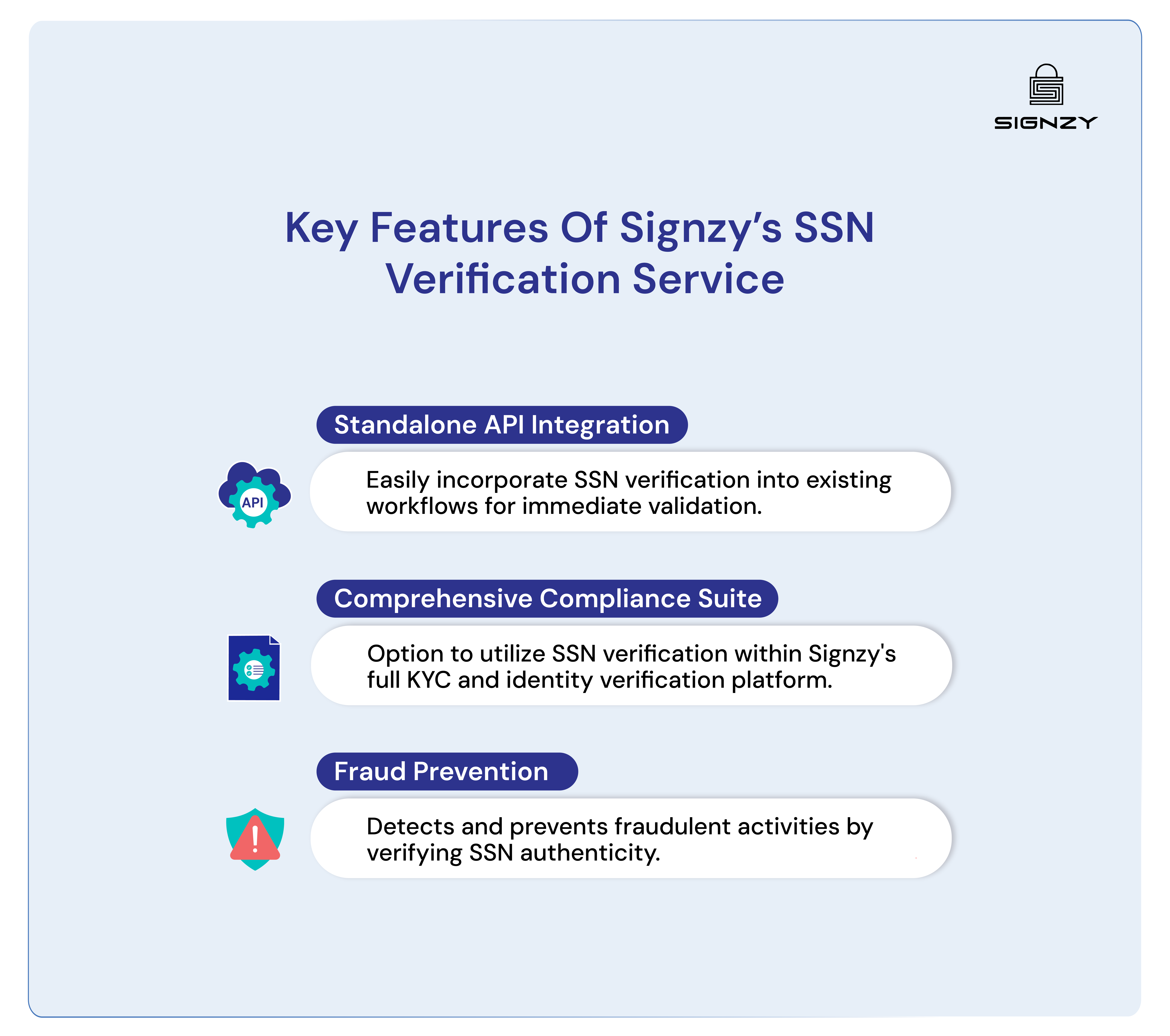
Signzy offers a versatile Social Security Number (SSN) Verification API that caters to businesses seeking both standalone verification and comprehensive compliance solutions. This flexibility allows organizations to integrate SSN verification directly into their existing systems or as part of Signzy’s broader Know Your Customer (KYC) and identity verification suite.
This SSN verification service is designed to enhance compliance procedures, prevent fraud, and streamline customer onboarding in the U.S.
We used to lose applicants because SSN steps kept glitching. With Signzy in place, people now instantly complete the flow and move on. Felt way smoother right away.
— Chief Risk Officer, Financial Services (200+ employees)

Key Features Of Signzy’s SSN verification service
Feature #1: Financial risk mitigation through KYC/AML checks
Challenge: Businesses cannot easily verify if a Social Security Number actually belongs to the person submitting it during onboarding.
Signzy confirms SSN ownership by matching applicant information against trusted databases in real-time. The platform identifies fraudulent applications before they enter your system and includes built-in AML screening to ensure financial institutions meet regulatory requirements while preventing unauthorized account access and identity theft attempts.
Feature #2: Comprehensive identity verification beyond basic validation
Challenge: Basic SSN checks only confirm the number exists but miss red flags like deceased person associations or suspicious patterns.
Signzy checks if the SSN was issued before the applicant's birth date, identifies when multiple people are using the same number, and flags addresses linked to mail drops or known fraud locations. This deeper analysis catches synthetic identities and fraudulent attempts that simple format validation cannot detect.
IRS CP2100 notices used to eat up our January every year. Since implementing SSN verification upfront, we've gotten maybe two notices total. That's down from dozens. My team actually has time for other work now. Thank you Signzy!
— Compliance Officer, Lending Platform (1000+ employees)
Feature #3: USA PATRIOT Act compliance for financial institutions
Challenge: Banks must complete thorough identity verification to meet federal regulations without slowing down their customer onboarding process.
Signzy automates SSN verification according to USA PATRIOT Act standards, generating the documentation needed for regulatory audits automatically. Financial institutions can onboard customers quickly while maintaining full compliance, eliminating manual verification steps and ensuring every identity check meets federal due diligence requirements.
Feature #4: Flexible integration for seamless workflow adoption
Challenge: Companies need SSN verification that works with their existing systems without requiring expensive rebuilds or long implementation timelines.
Signzy offers simple API integration that connects to your current platform in days for quick SSN checks, or a complete identity verification suite for broader compliance needs. Businesses can start with basic verification and expand capabilities later without changing their integration or disrupting existing workflows.
Pros and Cons
| Pros | Cons |
|---|---|
| Flexible integration options | A comprehensive suite may be more than needed for simple verification tasks. |
| Enhances compliance and fraud prevention | Focused primarily on the U.S. market |
| Streamlines U.S. customer onboarding |
2. Early Warning Verify Identity
Early Warning’s Verify Identity service assists financial institutions in preventing fraud by detecting false and synthetic identities before they enter the system. It provides a risk score and attributes and matches name, date of birth, and SSN in real-time. A unique aspect is its Identity Confidence Score, which assesses the likelihood that an applicant’s identity is genuine.
Key features of Early Warning’s SSN verification service
- Identity Confidence Score: Assesses the likelihood that the applicant is presenting their true identity credentials.
- Synthetic Identity Detection: Flags potential synthetic identities for further review.
- Real-Time SSN Verification: Confirms if the provided SSN matches SSA records.
Pros and Cons
| Pros | Cons |
|---|---|
| Enhances fraud detection capabilities | Primarily available to financial institutions |
| Provides comprehensive identity insights | It may require complex integration |
| Supports compliance with regulatory standards |
3. SentiLink eCBSV
SentiLink offers an Electronic Consent SSN Verification (eCBSV) service that validates name, date of birth, and SSN combinations directly with the SSA in real-time. This service is effective in reducing synthetic fraud and accelerating customer onboarding. A unique aspect is its pairing with SentiLink’s Synthetic Fraud Score, enhancing its effectiveness in discerning synthetic identities.
Key features of SentiLink’s SSN verification service
- Synthetic Fraud Reduction: Helps identify and prevent synthetic identities.
- Streamlined Onboarding: Eliminates the need for paper SSA-89 forms, speeding up the process.
Pros and Cons
| Pros | Cons |
|---|---|
| Provides authoritative SSN validation | Requires consumer consent |
| Accelerates the onboarding process | This may involve compliance with SSA regulations |
| Reduces risk of synthetic identity fraud |
4. Cisive Social Security Verification
Cisive’s Social Security Verification service enhances candidate background checks by conducting deep SSN scans. This service captures address history and aliases and verifies if the SSN has been associated with the candidate in consumer transactions. A unique feature is its comprehensive SSN trace, which provides detailed address and alias history, building a complete background profile.
Key features of Cisive’s SSN verification service
- Identity Association Check: Verifies if the SSN is linked to the candidate.
- Background Investigation Tool: Builds a complete profile for thorough background checks.
Pros and Cons
| Pros | Cons |
|---|---|
| High accuracy rate (99.9994%) in background checks | The verification process can take longer than competitors |
| Extensive data matching, beyond basic SSN validation | Not ideal for real-time or high-volume identity verification |
| Well-suited for regulated industries | User reports of occasional verification challenges |
5. Equifax Social Security verification services
Equifax provides a Social Security Number Verification service that enables businesses to instantly match an individual’s name, date of birth, and SSN directly with the Social Security Administration (SSA). This service is designed to reduce fraud and ensure compliance during the onboarding process. A unique aspect of Equifax’s offering is its ability to detect if an SSN is associated with a deceased individual, adding an extra layer of security.
Key features of Equifax SSN verification service
- Direct SSA Matching: Verifies personal identifiers directly with SSA records.
Deceased SSN Detection: Identifies if an SSN is associated with a deceased individual.
Pros and Cons
| Pros | Cons |
|---|---|
| Provides real-time verification | Requires SSA-89 consent form |
| Enhances fraud prevention | This may involve additional compliance steps |
| Reduces reliance on intrusive authentication methods |
6. LexisNexis Instant Verify
LexisNexis Instant Verify is an identity verification service that confirms personal information, including SSNs, to help businesses authenticate identities in real-time. This service utilizes extensive databases to provide immediate validation, reducing fraud and streamlining customer onboarding.
Users have praised its efficiency, with one user on G2 noting it "streamlines our program's identity verification process." However, the same user raised concerns about accuracy, commenting that it "does not always reliably capture inconsistencies in the customer's information." This highlights a trade-off between speed and comprehensive validation that organizations should consider when evaluating the platform even when reliable options like Signzy exist.
A distinctive feature is its comprehensive data sources, which enhance the accuracy of verifications.
Key features of LexisNexis’s SSN verification service
- Real-Time Verification: Provides immediate validation of personal information.
- Fraud Detection: Identifies discrepancies to prevent fraudulent activities.
Pros and Cons
| Pros | Cons |
|---|---|
| Immediate verification results | Access may require specific integrations |
| Extensive data coverage | Potential for false positives |
| Enhances compliance efforts |
7. Experian Social Search
Experian’s Social Search service assists businesses in verifying individuals’ identities by providing insights into their SSNs. This service helps in detecting potential fraud and ensuring the accuracy of customer information. A notable feature is its ability to provide associated address information for the SSN, offering deeper insights into an individual’s identity.
Key features of Experian SSN verification service
- Address History: Provides associated address information for the SSN.
- Deceased Indicator: Alerts if the SSN belongs to a deceased individual.
Pros and Cons
| Pros | Cons |
|---|---|
| Enhances identity verification processes | It may require access to Experian’s systems |
| Provides comprehensive SSN insights | Potential privacy considerations |
| Assists in fraud prevention |
8. Sumsub SSN Verification
Sumsub integrates SSN verification into its full-stack KYC compliance solution like Signzy. Instead of offering SSN checks as a standalone product, Sumsub combines them with identity verification, AML screening, and address confirmation to provide a seamless onboarding experience for businesses handling regulatory compliance.
While the platform offers comprehensive capabilities, users have noted limitations. One customer on G2 observed that "advanced customization options for KYC flows may be somewhat limited," adding that "many stakeholders in our company have been wanting to change provider, but the costs to change may not be worth it."
This suggests that organizations should carefully evaluate their customization requirements and consider potential switching costs before committing to the platform.
Key features of Sumsub’s SSN verification service
- SSN Matching: Confirms the validity of SSNs within regulatory frameworks.
- Fraud Detection: AI-driven analysis to detect synthetic identities.
- Multi-Layered Verification: SSN checks are part of a broader KYC process.
Pros and Cons
| Pros | Cons |
|---|---|
| Integrated with AML, identity verification, and compliance tools | Not a standalone SSN verification tool |
| Advanced fraud detection to flag synthetic identities | Requires API integration for large-scale use |
| Designed for seamless onboarding compliance | Pricing may be higher than basic SSN checks |
9. Social Security Administration (SSA) SSN Verification
SSA’s Social Security Number Verification Service (SSNVS) is a government-run tool designed for employers to validate employee SSNs for wage reporting accuracy. While it is free and directly tied to SSA records, it is not intended for real-time or customer identity verification at scale.
Businesses that need instant results for onboarding customers will likely find SSA’s solution inefficient due to processing limitations and its lack of fraud detection capabilities.
Key features of SSA’s SSN verification service
- Direct SSA Data Matching: Ensures SSNs align with SSA records.
- Free for Registered Employers: No cost for businesses that meet SSA requirements.
Pros and Cons
| Pros | Cons |
|---|---|
| Free for registered employers | Limited to employee wage reporting; not for customer verification |
| Bulk SSN verification capabilities | No real-time verification; results take up to one business day |
| Direct government data source | No fraud prevention or risk assessment tools |
10. Veriff
Veriff's SSN verification service helps businesses confirm user identities with speed and accuracy. Cross-referencing SSNs with trusted databases reduces fraud risks and ensures regulatory compliance. The service integrates seamlessly via API, making it ideal for fintech, financial services, and other regulated industries.
User feedback reveals mixed experiences with the platform. One user praised it as a "reliable and intuitive tool that improved my productivity." However, the same individual noted that "the learning phase is a bit difficult for someone who is non-technical."
Another user cautioned that,
"If you're uncertain about long-term needs, it can result in wasted time and resources for both parties involved."
Key features of Veriff’s SSN verification service
- Automated SSN Data Matching: Instantly verifies SSNs against official records.
- Fraud Prevention: Detects inconsistencies and minimizes identity fraud risks.
Pros and Cons
| Pros | Cons |
|---|---|
| Fast, automated SSN verification | Requires API integration |
| Strengthens fraud prevention | Pricing may not suit smaller businesses |
| Enhances compliance for regulated industries | Additional verification is needed for flagged cases |
💡 Related Blog:

Signzy benefit: Conducting SSN verification at scale
As businesses grow, they need SSN verification that can handle more customers without slowing down or breaking the bank. Most verification services make you choose between thorough checks and fast processing, creating delays during customer onboarding. Others lock you into expensive contracts that become costlier as your business expands.
| Metric | Signzy |
|---|---|
| API response time | <3 seconds |
| False positive rate | <2% |
| Monthly verification capacity | 100M+ |
Signzy solves these scaling challenges with a platform built for growth. Here’s all you need to know:
🔗 Seamless integration with EIN verification
Businesses often need to verify both individual Social Security Numbers and Employer Identification Numbers during onboarding.
Signzy allows you to combine SSN verification within EIN verification workflows, creating a unified validation process for complete business and individual identity checks. This integration streamlines onboarding for business accounts without requiring separate verification tools or manual coordination between systems.
🌍 Global reach with local compliance
While SSN verification focuses on the U.S. market, Signzy operates across 180+ countries worldwide. Businesses expanding internationally can use the same platform for identity verification in multiple regions, maintaining consistent security standards and compliance practices across all markets without managing separate verification providers for each country.
🧩 Complete U.S. API marketplace within one system
Businesses rarely need just SSN verification alone. Signzy provides access to a complete U.S. API marketplace where you can add modules as your requirements expand, all within the same system. Need to verify driver's licenses, passports, EINs, or conduct AML screening? Simply activate additional APIs without switching platforms or managing multiple vendor relationships.
This modular approach lets you build a comprehensive verification ecosystem that evolves with your business needs.
💰 Pay only for what you use
Traditional verification services charge fixed fees or require expensive contracts that penalize growth. Signzy uses pay-as-you-go pricing, so you only pay for the verifications you actually run. This cost structure makes comprehensive identity validation affordable for startups processing dozens of checks monthly and enterprises handling thousands, with no hidden fees or volume commitments that strain your budget.
Signzy didn’t throw strange surprises at us. SSN checks come back clean, logs readable, and integration wasn’t some nightmare project. Nice change from the chaos we had before.
— Senior Engineer, HR SaaS (100+ employees)
If you’d like to know more about how SSN verification API can fit in your workflow, book a demo here.


FAQ
Can I verify an SSN without the person’s consent?

Which SSN verification service is best for fintech companies?
Can businesses verify SSNs in real-time?
What’s the difference between standalone SSN verification and full KYC?
How much does SSN verification cost?
Is SSN verification required by law for businesses?
Can an SSN verification service tell if a Social Security Number has been stolen?
Gaurav Gupta
Gaurav Gupta is the Global Product Head at Signzy, leading the strategy and development of the company’s KYC, KYB, AML, and digital onboarding products used by banks, fintechs, and financial institutions across global markets. He specializes in building scalable compliance and verification platforms, transforming complex regulatory and risk workflows into seamless, automated product experiences. Gaurav works at the intersection of product, engineering, and AI.

Related Blogs
View all




The best in business


The global API marketplace for KYC, KYB, & AML
Explore the end-to-end verification stack trusted by 1,000 businesses.
Get in touch